- How does the airport operate?
- Your Area
- What are we doing?
- Additional Information and FAQs
Site Contents Page

Behind the Scenes: Understanding Airport Operations and Aircraft Activity
Welcome to the London Stansted Airport Noise Information Portal. This portal provides information about how the airport operates, how we manage noise, and how many flights operate close to your location. The portal also offers informational videos, general information, as well as visualisations of a typical day at the airport and dashboards containing data relevant to your location.
When you first enter the site, you will be asked to enter your location. You can do this by entering your address or dropping a pin on a map and pressing ‘Continue’.
Once you have entered your location, the pages under the heading “Your Area” will automatically update and tailor the information to be specific to your location. These pages provide detail about flights in the vicinity such as the frequency and height of aircraft for different time periods of the day. This data is generated from our highly accurate Aircraft Noise and Operations Monitoring System (ANOMS) that tracks aircraft movements within 40 Nautical Miles of the airport. You can change your location at any time using the “select location” button in the top right corner.
A number of pages contain interactive dashboards. Data is updated in the middle of the month, to then show the most recent full calendar month in this portal. The dashboards first load with the most recent months data, but you can change the month selected by using the drop down menu.

To view the dashboard as a full screen, there is a button on the top right corner of the dashboard called “View Fullscreen”. Pressing ‘ESC’ on your keyboard will exit the full screen display.
You can navigate through each page in order via the next button at the bottom of the page. You can also return to the main menu via the ‘back to menu’ button which will take you back to the home page.
To ensure a safe take-off and landing, aircraft depart and arrive into the wind. On take-off, this helps produce the lift required to get airborne and landing into the wind enables a slower speed over the ground. The weather and wind direction can change and therefore the direction that the aircraft are arriving and departing may change to ensure the safest conditions to operate.
Air Traffic Control manages the runway direction for the safest aircraft operations. This includes consideration of the wind at ground level, 1000ft, and 2000ft, as well as the forecasted weather. Local weather forecasts only display wind strength and direction at ground level and this can differ at higher altitudes. Therefore local weather forecasts are not always a reliable indicator of the likely direction that aircraft will be operating.
When the wind is blowing from west to east, the airport will operate in a westerly direction, known as “westerly operations” and the reverse during “easterly operations”. Experience of operations at London Stansted Airport shows an average of over 70% of operations, each year, are westerly and the remaining operations in an easterly direction. The 70/30% split is an annual average and there are months with a much higher/lower proportion of westerly/easterly operations. An image demonstrating the direction of operations can be seen below:
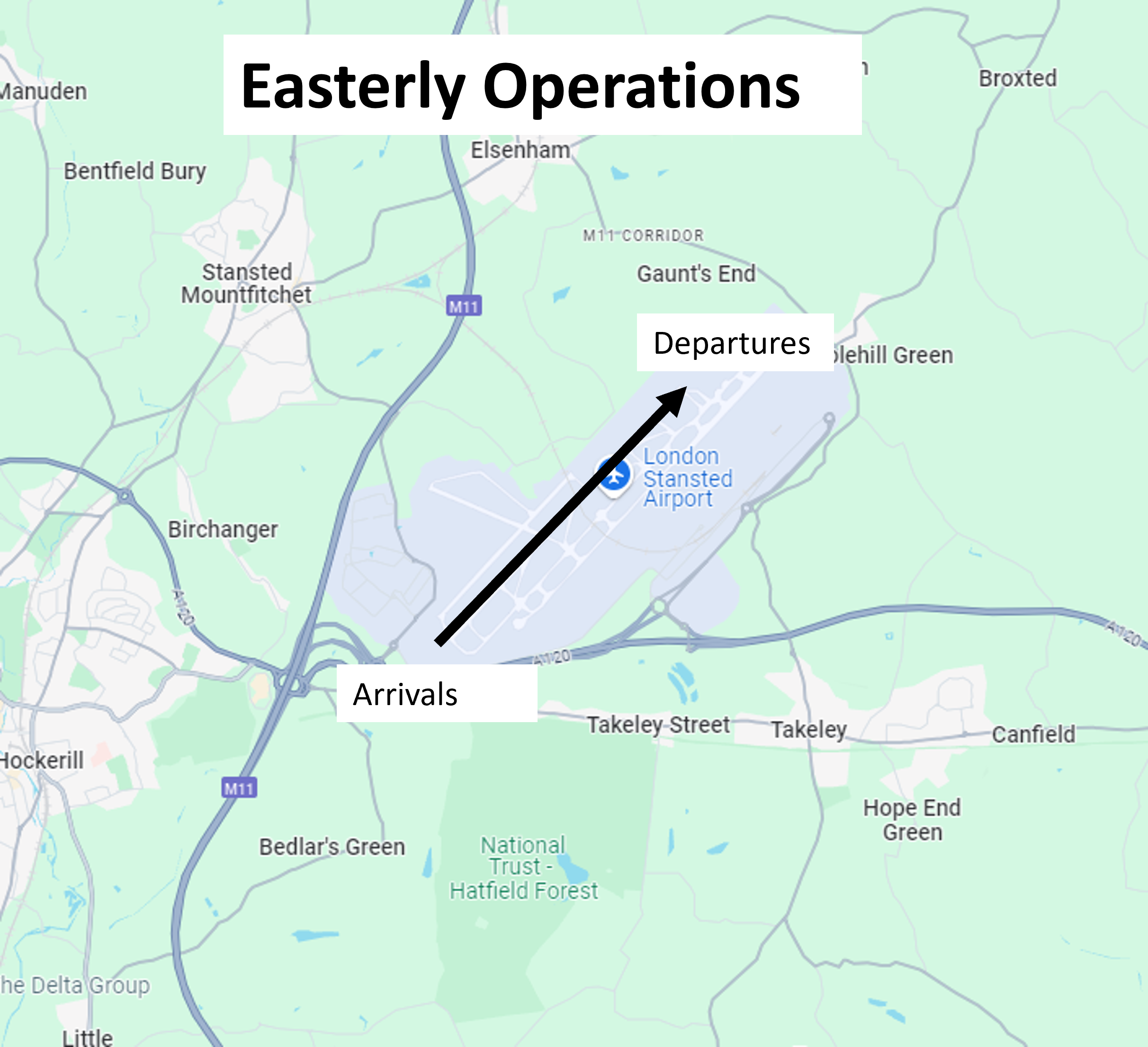
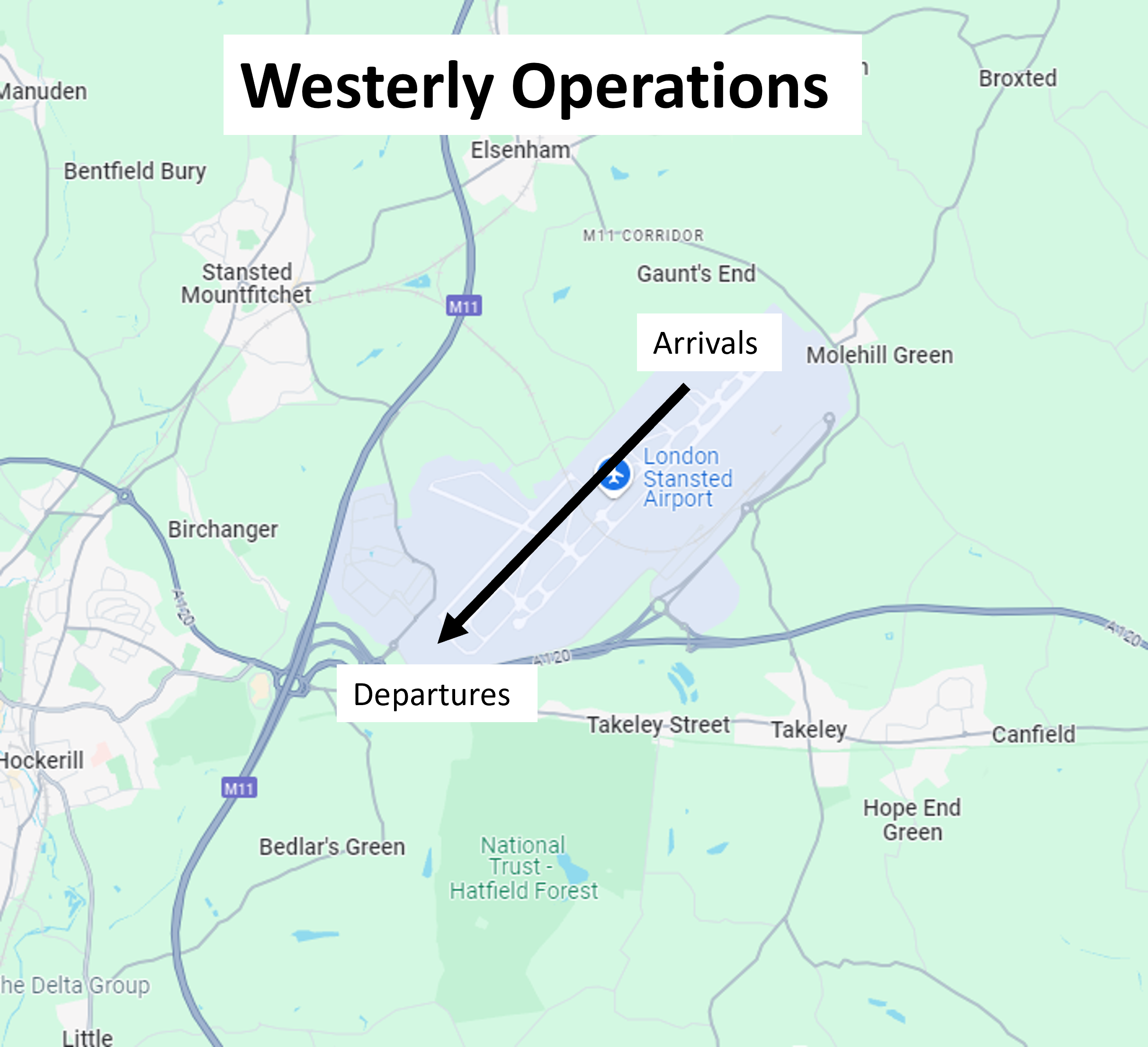
Flight paths for arriving aircraft follow broadly similar patterns, unlike departures which are much more defined. The flight paths ensure separation from other air traffic and avoidance of adverse weather when necessary. This means that there may be variation in airport arrivals at different times of the day.
Aircraft arriving into London Stansted Airport are transferred from the NATS area control centre to the Air Traffic Control approach controller, who sequences aircraft into the arrival pattern. They are then instructed where to fly by the Air Traffic Controllers, where they are directed towards their final approach before landing. When established on final approach to London Stansted Airport, aircraft are transferred from the approach controller to the tower controller before landing.
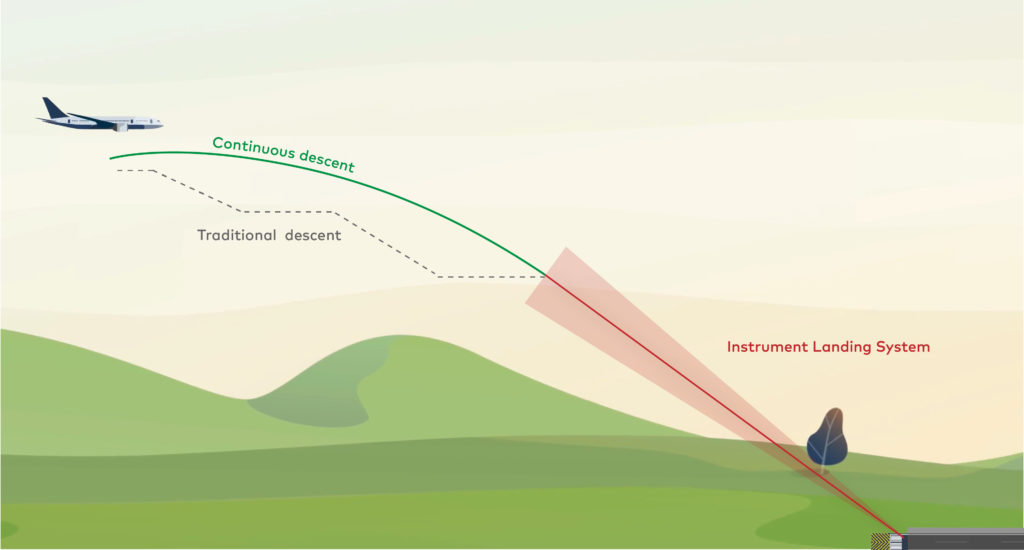
To minimise the noise of approaching aircraft for communities near arrival paths, a ‘Continuous Descent Approach’ (CDA) is used when possible. Instead of a traditional descent whereby the aircraft reduces altitude in a stepped manner (similar to walking downstairs), they glide at a more constant rate (like an escalator). This keeps aircraft at a higher altitude for longer, minimising noise for local residents before an aircraft joins the ILS (the red shaded area in the image below), as well as providing benefits for fuel efficiency and reducing emissions. Operating a CDA is not always possible due to several factors such as congested airspace or adverse weather conditions which need to be avoided. With the London Stansted Future Airspace project, we plan to facilitate changes that will make CDA easier to deliver. Compliance with this procedure is reported on here and you can find out more about arrivals at London Stansted Airport in the following video.
Please note this video is orientated as if you are positioned on the North of the airfield, looking towards the South.
Departing aircraft move on the ground from their stands to the runway using taxiways. At the runway, they then await clearance from Air Traffic Control (ATC) to take-off. The weight of a departing aircraft can vary due to the amount of fuel, passengers, luggage, or cargo, and there can be a difference in the noise generated as the aircraft accelerates along the runway to become airborne.
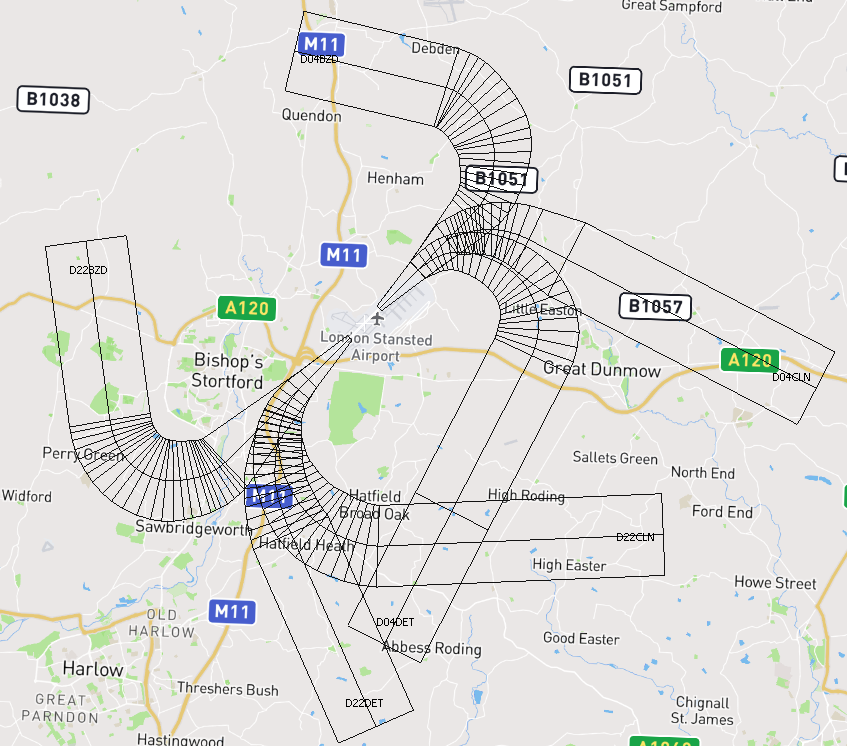
Depending on the aircraft’s destination, the departure will fly one of a number of departure routes (known as Noise Preferential Routes or NPRs). These routes are flown to minimise the overflight of local communities, whilst ensuring separation with other departures and surrounding air traffic, as well as optimising routing to the destination. The NPRs can be seen below. You can find out more about London Stansted Airport departures in the following video.
Please note this video is orientated as if you are positioned on the North of the airfield, looking towards the South.
Aircraft must remain within the NPR until they reach a minimum altitude of either 3,000ft or 4,000ft (depending on the route and time of day or night) after which ATC can provide a more direct routing to the destination. For safety reasons, ATC may sometimes provide instruction to an aircraft to exit the NPR earlier to avoid adverse weather or other air traffic. Compliance with this procedure (known as track keeping) is reported on here.

Every major commercial airport typically has set flight paths for departing aircraft from their runways. These are in place to maintain safety and whilst safety is always the number one priority, these routes are designed to minimise environmental impact as much as possible in terms of fuel burn, emissions and noise impacts. However, airspace congestion and local weather, such as thunderstorms, may result in a large spread in flight paths. Arriving aircraft follow broadly similar patterns, which are not as defined as the flight paths for departing aircraft. Aircraft are directed by ATC to a position where they turn onto a runway heading (the direction of the runway that the aircraft will land on) before making its final approach. At London Stansted Airport there is an Instrument Landing System (ILS) that guides the airport during its final approach to the runway.
The typical flight paths used at London Stansted Airport are shown in the following interactive tool for both westerly and easterly operations. All data has come directly from our Aircraft Noise and Operations Monitoring System (ANOMS), which receives flight data from air traffic control radar. This system is operational 24 hours a day, 7 days a week, continuously tracking and recording aircraft flights to and from the airport. Flight tracks are recorded from radar data centred at the airport. The reason you will see radar tracks ending is because the extent of our radar coverage is 40nm (nautical miles). The graphic below shows arriving aircraft as red tracks with departing aircraft shown as green tracks.

When airports are busy, there can be a build up of aircraft waiting to land, and so aircraft can be placed in a holding stack.
A stack is a fixed circling pattern in which aircraft fly whilst they wait to land. The primary use of a stack is to delay an arriving aircraft due to aircraft congestion, sometimes due to poor weather conditions (e.g. snow clearing) or runway unavailability.
London Stansted Airport has two holding stacks; one called ‘LOREL’ which is located Northwest of the airport and the second, ‘ABBOT’ is located Northeast of the airport. The minimum altitude of aircraft in the stack is 7,000ft in the LOREL hold and 8,000ft in the ABBOT hold, and is set to keep noise on the ground as low as possible. The height of the holding stacks extends up to 14,000ft.
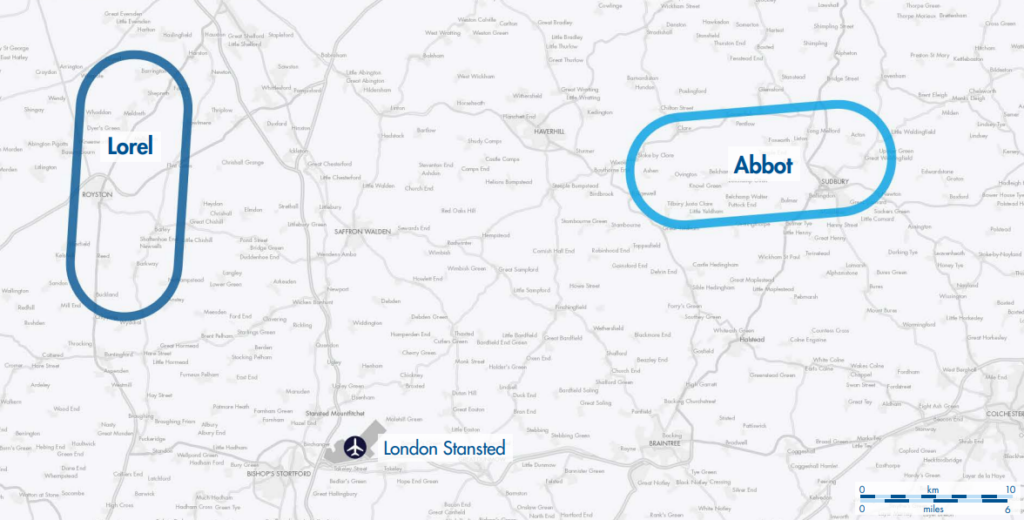
Air Traffic Control (ATC) must ensure there is a safe gap between each aircraft as they come in to land. To achieve this, aircraft will sometimes circle around in the stack until air traffic controllers are able to fit them into the landing pattern. Aircraft are required to carry extra fuel specifically for holding, should this become necessary. Any aircraft with an emergency would take priority and bypass the stack.
You can find out more by watching this video:
People living between the stack and the final approach may hear noise as the aircraft leaves the stack and makes their way to the final approach to London Stansted Airport. As there are no set heights or routes for arriving aircraft, once they have left the stack, aircraft are directed individually by ATC to ensure they are safely spaced for arrival. Therefore, they can legitimately go anywhere they are directed. ATC do this to ensure high levels of safety and efficiency.

As the world becomes more connected, there is a growing demand for air transport, which includes passenger and cargo connectivity around the world, into and out of different time zones. Not only does this make it easier for people to travel for holidays and to see friends and family, but it also helps businesses and the local economy by providing transportation links for time critical goods and services.
London Stansted Airport is one of three airports which have been designated by the Government using powers contained in the Civil Aviation Act 1982. Therefore, most of the controls on night-time flying at Stansted Airport are directly imposed by the Government. The Department for Transport (DfT) is responsible for setting the restrictions. London Stansted Airport strictly monitors compliance with all the restrictions in place. The airport reports weekly on compliance to both the DfT and our airlines. We also report regularly to the Stansted Airport Consultative Committee (STACC) – an independent consultative group made up of representatives from local authorities, councillors, businesses, airlines and the DfT.
London Stansted Airport has always been a 24-hour, seven days a week operation. We recognise however, that at night when there is less background noise, aircraft noise may be more intrusive. Stansted attaches a high priority to managing the noise impacts associated with night operations. So we have chosen to voluntarily enhance the Government’s controls by implementing more stringent measures, including restricting the operation of noisier aircraft types and imposing lower noise penalty limits. Our night noise controls are intended to strike a balance between the economic and social benefits a thriving airport provides and the disturbance which can be caused by night flights.
Aircraft are certified by the International Civil Aviation Organisation (ICAO) according to the levels of noise they produce. They are classified separately for both take-off and landing. Points are allocated to different aircraft types according to how noisy they are. The noisier the aircraft type, the higher the points allocated. This provides an incentive for airlines to use quieter aircraft types.
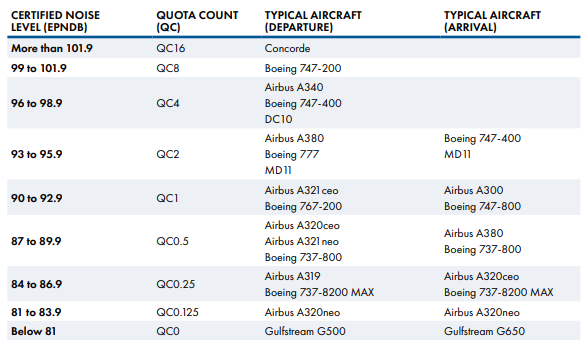
London Stansted Airport has procedures in place to minimise the disruption caused by night flights. These procedures have evolved through consultation with local communities as part of the Noise Action Plan process. The night period is defined as 23:00 to 07:00 hours (local). During this time the following restrictions apply:
You can read more about how we manage night noise under the ‘What are we doing’ heading, within the ‘How we manage noise’ section.

Helicopter operations at London Stansted Airport are daily occurrences and as with fixed wing aircraft operations, they conform to many operating restrictions, industry codes of best practice and legislation relating to their safe operation. London Stansted Airport is a 24-hour operation and as such, helicopters can operate at any time, and they depart and arrive using the runway.
Most helicopters operating at London Stansted Airport operate under ‘Visual Flight Rules’ and do not fly the Noise Preferential Routes (NPRs) when departing as commercial jet aircraft do. Similarly, helicopters do not arrive in the usual patterns seen with commercial jet aircraft. The pilot navigates using “visual” ground-based features such as roads and rivers which are clearly identifiable from the air. These visual features will not be as visible at night and so many helicopters are now equipped with satellite navigation
equipment which includes a database of all navigation features, including these ground-based features.
The government has set restrictions on the numbers and types of aircraft that can operate throughout the night, these restrictions also apply to helicopters. More information can be found on the ‘Night Flights’ page.
Helicopters operate in accordance with the low flying rules contained within The Rules of the Air Regulations 2007 – these state that except with the written permission of the Civil Aviation Authority, an aircraft flying over a congested area of a city, town or settlement shall not fly below a height of 1000ft above the highest fixed obstacle within a horizontal radius of 600 metres of the aircraft.
There are exemptions to the low flying rules when departing or landing at an aerodrome, they include Police and Air Ambulance helicopters which have special dispensation to operate safely at lower levels and may also hover for extended periods. Military helicopters (and aircraft) are not governed by these civil regulations.
The maximum height that helicopters can operate in controlled airspace around the airport is 2000ft. There is a safety requirement for helicopters and other light aircraft to remain a safe vertical and lateral distance away from other aircraft at all times.
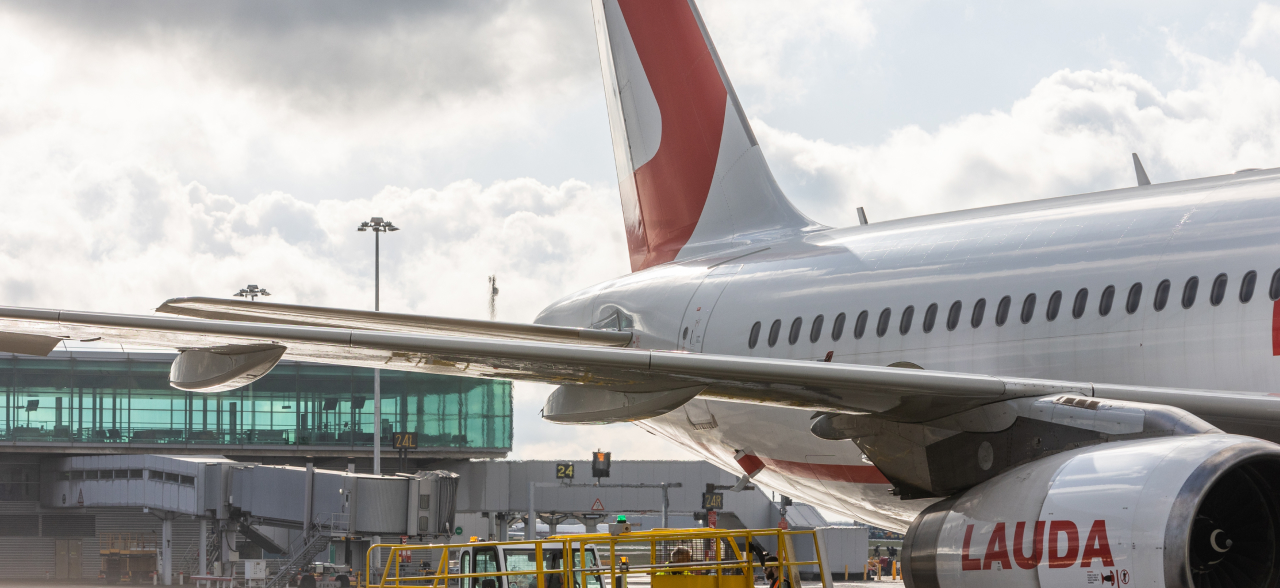
From time to time you may notice an unusual aircraft operation at or around the airport. Below are a number of examples of unusual operations that you may see at London Stansted Airport.
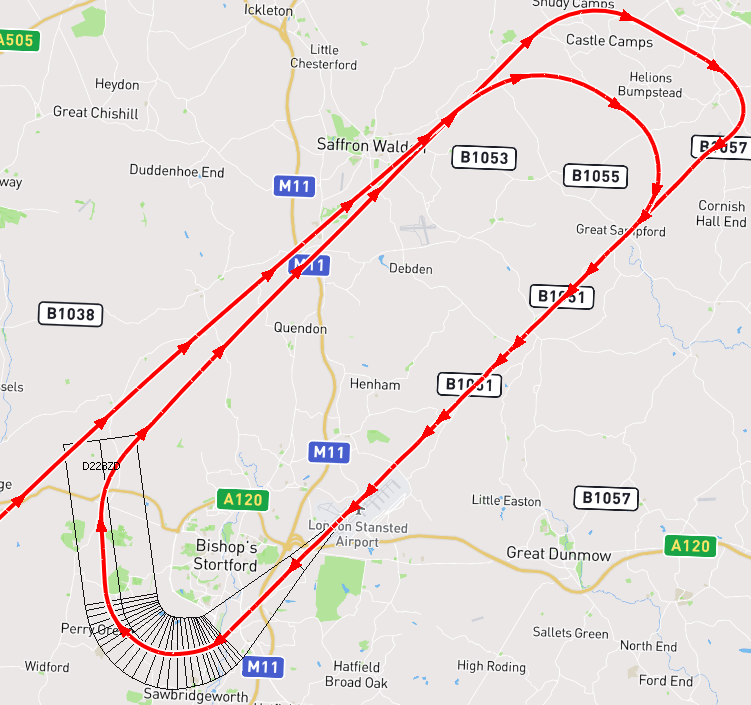
A go-around, or missed approach, can occur for many reasons such as, an obstruction on the runway preventing the aircraft from landing safely, a change in the wind conditions or that the aircraft cabin is not secure for landing. When coming into land, if a go-around is initiated, the pilot will apply thrust to climb straight ahead and then either turn left or right. Because a go-around can occur at any stage of the approach, the climb and turn could occur before or after reaching the runway. The exact path taken by an aircraft going around will be dependent on surrounding air traffic, the weather, the direction of operation and the point at which it is initiated. However, standard missed approaches, where possible, follow the Buzad Noise Preferential Route.
The aircraft will then be directed by Air Traffic Control who will then position the aircraft to make a second approach to the runway to land. This may mean that aircraft performing a go-around could overfly areas they do not normally at potentially lower than expected altitudes. On occasion, it is not possible to follow a standard missed approach and on these rare occasions, aircraft will be directed by Air Traffic Control to maintain a safe separation from all other air traffic and may overfly areas not usually overflown.
You can find out more by watching this video:
An example of a go-around on Runway 22 (Westerly Operations) can be seen below. As you can see the aircraft took a right turn and orbit around to re-establish for a second, successful, approach on to Runway 22:
On occasions, military aircraft operate at London Stansted Airport. We are limited in our ability to mitigate against the noise impacts of these types of aircraft, however, they are still required to operate within the existing regulations that apply to our regular commercial traffic. Depending on the type of aircraft, noise suppression can be limited.
Copyright 2025. London Stansted Airport plc. All Rights Reserved.


