
The balanced approach
The International Civil Aviation Organisation (ICAO) has developed the concept of a ”balanced approach” to aircraft noise management. This approach incorporates four key elements to the mitigation of noise levels at airports, which has been endorsed under the EU Directive 598/2014. This aligns with the UK Government policy on aviation noise, which can be found here.
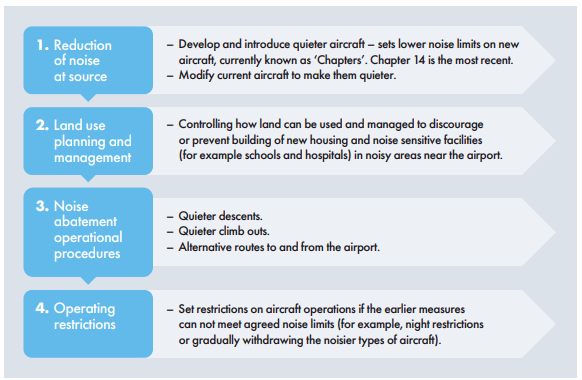
- Reducing noise at source: Reduce the noise produced by the aircraft itself through continual design and engineering improvements. Over the past 30 years efforts in this category have led to dramatic reductions in aircraft noise where newer aircraft are much quieter than their predecessors.
- Land-use planning and management: Support local and national Governments to manage land use around airports and under flight paths to limit the number of new residential properties built in areas exposed to aircraft noise.
- Noise abatement operating procedures: Encourage aircraft operators to fly their aircraft in the optimal low-noise configuration and work with air traffic control (ATC) to enable that configuration.
- Operating restrictions: Banning or limiting operations, this is the most difficult part of the balanced approach to implement as it has to align and operate within other Governmental restrictions.
How London Stansted Airport manages noise
Knowing where aircraft fly and how well they are complying with airport noise mitigation rules helps everyone to improve operations and keep the noise exposure to the absolute minimum. The airport is acknowledged as a noisy place, but steps can be taken to abate that noise as much as possible. Our noise strategy can be viewed here.
- Night Quota Management: A quota count limit and movement limit applies to the core night period 23:30-06:00. The restrictions are divided into summer and winter seasons.
- Reducing noise at source: Encouraging airlines to operate modern, low noise aircraft.
- We currently operate a noisy aircraft penalty scheme which penalises aircraft which exceed published noise limits at night (between 23:00 and 07:00). Money raised from noisy aircraft penalties is donated to the Airport Community Fund.
- Land-use planning and management: Regularly produce noise contours for use by Government Authorities to manage the planning process. These contours show the typical noise exposure for an average day over the year.
- Our commitment for serving up to 35 million passengers exists as a 57dB LAeq 16h daytime contour limit of 33.9km2. Once passenger numbers exceed 35mppa, a 54dB LAeq 16h daytime contour limit of 57.4km2 and a 48dB LAeq 8h night contour of 74.0km2 then becomes the contour limits. By the end of 2032, or the first year that passenger throughput reaches 43mppa, a 54dB LAeq 16h daytime contour limit of 51.9km2 and a 48dB LAeq 8h night contour of 73.6km2 then becomes the contour limits.
- Noise abatement operating procedures: Encourage aircraft operators to fly their aircraft in the optimal low-noise configuration and where appropriate monitoring compliance against these procedures with data reported as part of our regular reports.
- Continue to promote and report figures for: Continuous descent approaches (CDA) enable aircraft to perform a gradual descent as opposed to a stepped one. This keeps aircraft higher for longer, reducing the noise experienced on the ground.
- Continue to promote and report figures for: Continuous climb departures enable aircraft to keep climbing after take-off until they reach their cruise altitude. Continuous climbs can increase the height of the aircraft closer to the airport and make noise levels less audible.
- Continue to promote and report figures for: A noise preferential route (NPR) is one that directs an aircraft along an agreed route to avoid areas of population. At London Stansted, we have a target of 99% of departing aircraft remaining with in the NPRs.
- Operating restrictions: Where appropriate, the airport tracks compliance against the restrictions, which include night flight restrictions with compliance reported as part of our regular reports.
- London Stansted Airport prohibits airlines from scheduling and operating the noisiest aircraft types at night 23:00 – 07:00. These are classified as having a Quota Count (QC) of 8 or 16. QC 4 aircraft are prohibited from operating during the core night period 23:30-06:00.
The Airport’s Noise Monitoring and Management System (ANOMS) is configured to analyse compliance with all of these procedures, providing data and analytics to airport staff. This data can be extremely useful to determine trends, identify non-compliant performance, and could inform future planning such as to engage directly with the airline to improve overall performance.
An example of a Continuous Descent Arrival:
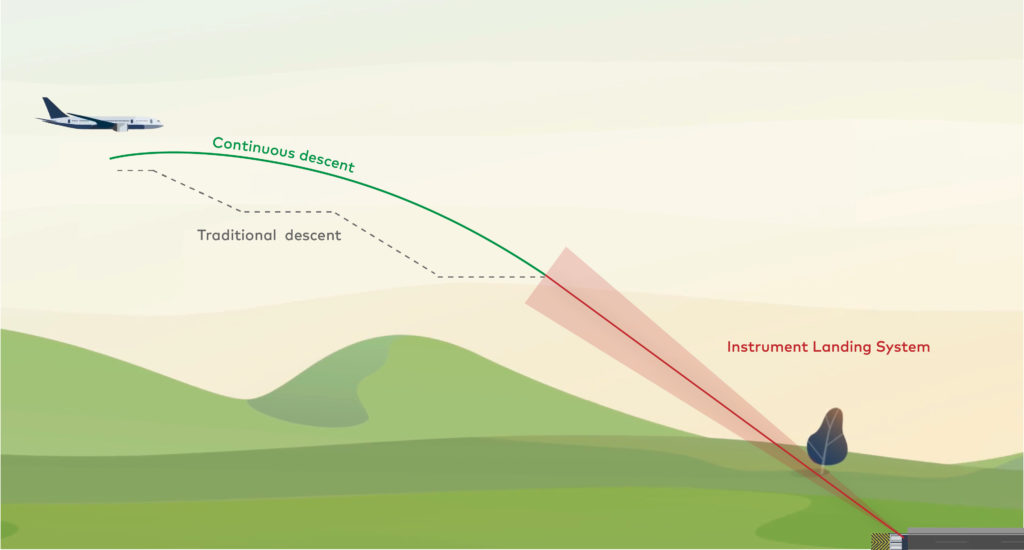
At London Stansted Airport, we have a target that 94% of aircraft arriving on Runway 22 will perform a CDA. The complexity of London airspace means that it is often not possible for aircraft arriving on Runway 04 to perform a CDA. Airspace constraints require air traffic controllers to lower aircraft approaching Stansted Airport earlier than necessary to separate them from aircraft arriving at or departing from other London airports. However, we work with air traffic controllers to meet an informal target that, during the core night period (23:30 to 06:00) when London airspace is less congested, 65% of aircraft arriving on Runway 04 will perform a CDA.


