
How we calculate overflight
You can easily determine if an aircraft is overflying your area by looking at the tail. If you can see the tail, the chances are the aircraft is too far away from you to be counted in our statistics. The following two videos explain how you can determine overflight and how our system calculates location-specific data used on this website.
The grid
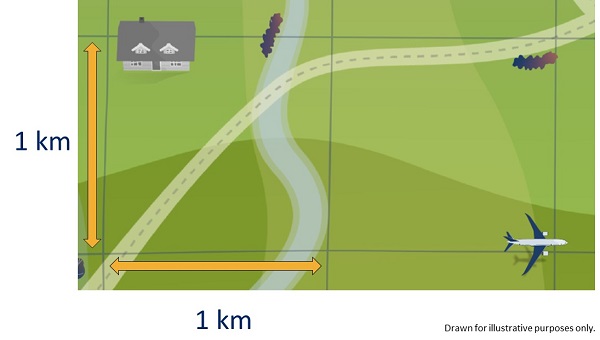
To be able to analyse the number of flights over an area around the airport, we have created a grid of identically sized, 1 kilometre by 1 kilometre squares. In total, the grid extends for 40nm (nautical miles) around the runway, ranging from certain identified towns and landmarks. 40nm is approximately the extent of our radar coverage and the data in our noise and track keeping system (ANOMS).
How we count the number of flights
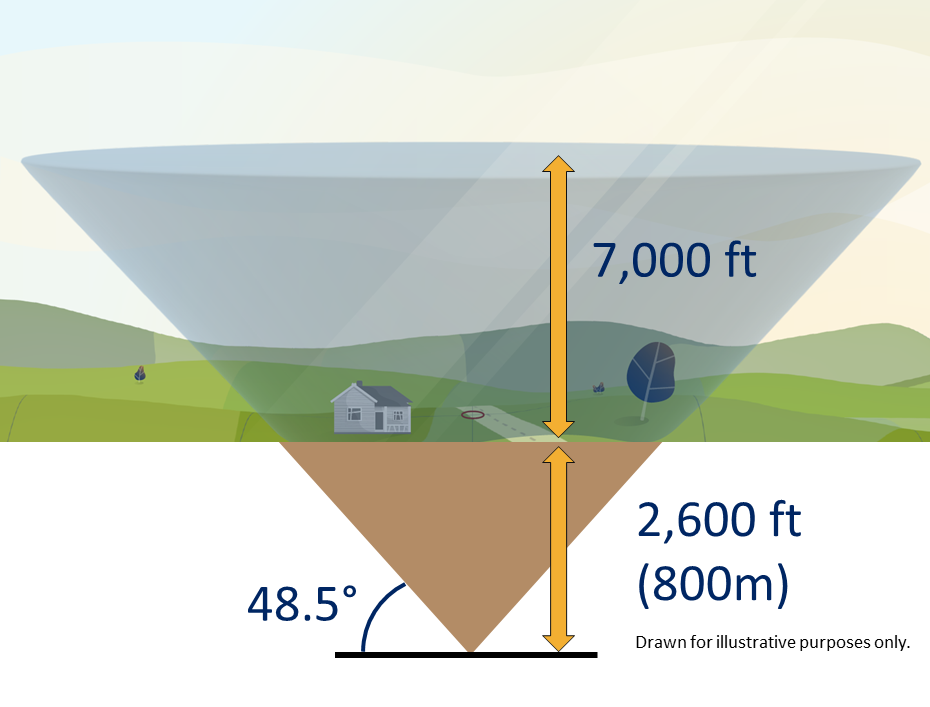
We start by drawing a cone in the centre of each grid. Using the location that you provided when you entered the site, we determine the nearest cone to you.
Flights that pass through each cone are recorded and that data is presented on this website.
To ensure we capture as much overflight data as possible and to fully cover all locations in our grid, we have lowered the cone by 2,600 feet (800 metres) into the ground. This is to ensure that all locations within the 1km grid are captured by the cone that extends above. The cone extends up to 7,000 feet (2.1 kilometres) above local ground level and at the very top, the cone is over 5 kilometres wide. This is for indicative purposes only and therefore differs from the CAA methodology for calculating overflight, as used in support of the London Stansted Airport airspace change proposal.
Why we use a cone
We use a cone at a 48.5 degree angle because research undertaken by the UK Civil Aviation Authority (CAA) identified that a cone best aligns with how we determine if an aircraft has overflown a location or not.
The 48.5 degree angle of the cone was selected as it incorporates an evaluation of noise, in that if one aircraft flew directly above the observer, followed by a second aircraft off to the side along the 48.5 degree line, the second aircraft would be 3 decibels quieter than the first.
Where does the data come from?
All data used in our system comes directly from our Aircraft Noise and Operations Monitoring System (ANOMS), which receives flight data from Air Traffic Control radar.


