
Introduction
As the world becomes more connected, there is a growing demand for air transport, which includes passenger and cargo connectivity around the world, into and out of different time zones. Not only does this make it easier for people to travel for holidays and to see friends and family, but it also helps businesses and the local economy by providing transportation links for time critical goods and services.
London Stansted Airport is one of three airports which have been designated by the Government using powers contained in the Civil Aviation Act 1982. Therefore, most of the controls on night-time flying at Stansted Airport are directly imposed by the Government. The Department for Transport (DfT) is responsible for setting the restrictions. London Stansted Airport strictly monitors compliance with all the restrictions in place. The airport reports weekly on compliance to both the DfT and our airlines. We also report regularly to the Stansted Airport Consultative Committee (STACC) – an independent consultative group made up of representatives from local authorities, councillors, businesses, airlines and the DfT.
London Stansted Airport has always been a 24-hour, seven days a week operation. We recognise however, that at night when there is less background noise, aircraft noise may be more intrusive. Stansted attaches a high priority to managing the noise impacts associated with night operations. So we have chosen to voluntarily enhance the Government’s controls by implementing more stringent measures, including restricting the operation of noisier aircraft types and imposing lower noise penalty limits. Our night noise controls are intended to strike a balance between the economic and social benefits a thriving airport provides and the disturbance which can be caused by night flights.
Aircraft Certification
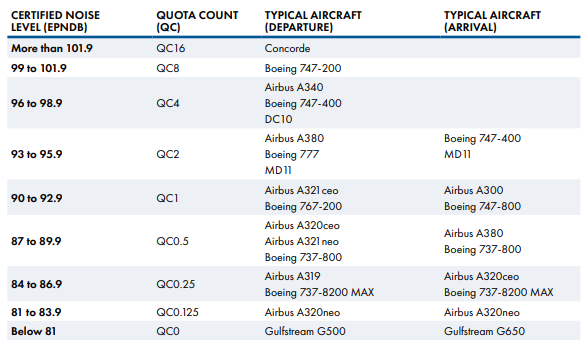
Aircraft are certified by the International Civil Aviation Organisation (ICAO) according to the levels of noise they produce. They are classified separately for both take-off and landing. Points are allocated to different aircraft types according to how noisy they are. The noisier the aircraft type, the higher the points allocated. This provides an incentive for airlines to use quieter aircraft types.
Restrictions in place
London Stansted Airport has procedures in place to minimise the disruption caused by night flights. These procedures have evolved through consultation with local communities as part of the Noise Action Plan process. The night period is defined as 23:00 to 07:00 hours (local). During this time the following restrictions apply:
- To encourage airlines to fly as quietly as possible at night, we operate a noisy aircraft penalty. Using our noise monitoring system, we measure the level of noise generated by each departing aircraft. Noise is measured by monitors positioned at fixed points beneath the departure flight paths. Money raised from noisy aircraft penalties is donated to the London Stansted Airport Community Fund which supports local good causes.
- The noisiest types of aircraft cannot be scheduled between 23:00 to 07:00. Aircraft rated at QC8 and QC16 are banned from operating between 23:00 and 07:00. Aircraft rated at QC4 are banned from operating between 23:30 and 06:00.
- The Government imposes a night quota and movement limit to the Core Night period 23:30-06:00.
You can read more about how we manage night noise under the ‘What are we doing’ heading, within the ‘How we manage noise’ section.


