
Wind and Runway Direction
To ensure a safe take-off and landing, aircraft depart and arrive into the wind. On take-off, this helps produce the lift required to get airborne and landing into the wind enables a slower speed over the ground. The weather and wind direction can change and therefore the direction that the aircraft are arriving and departing may change to ensure the safest conditions to operate.
Air Traffic Control manages the runway direction for the safest aircraft operations. This includes consideration of the wind at ground level, 1000ft, and 2000ft, as well as the forecasted weather. Local weather forecasts only display wind strength and direction at ground level and this can differ at higher altitudes. Therefore local weather forecasts are not always a reliable indicator of the likely direction that aircraft will be operating.
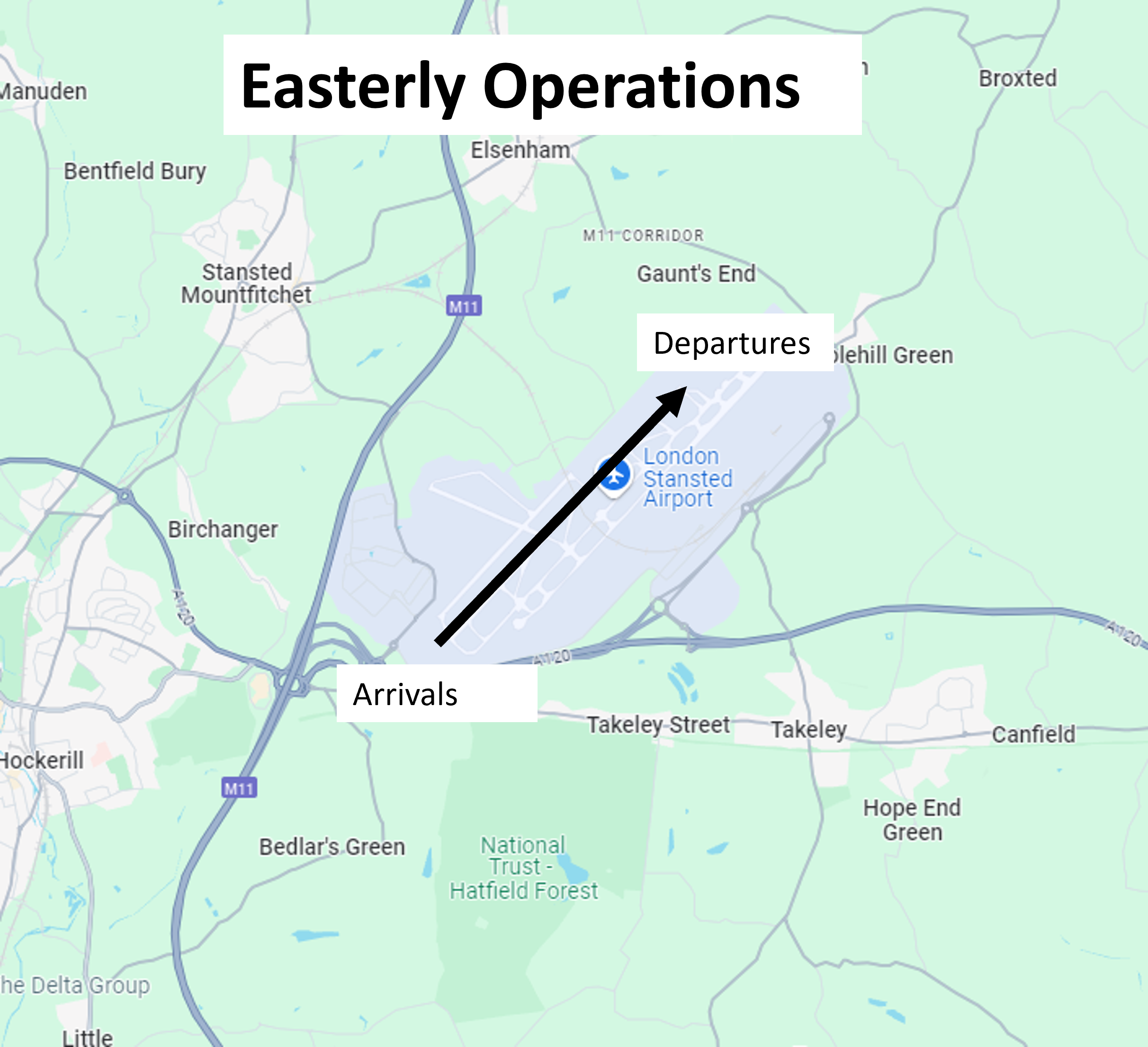
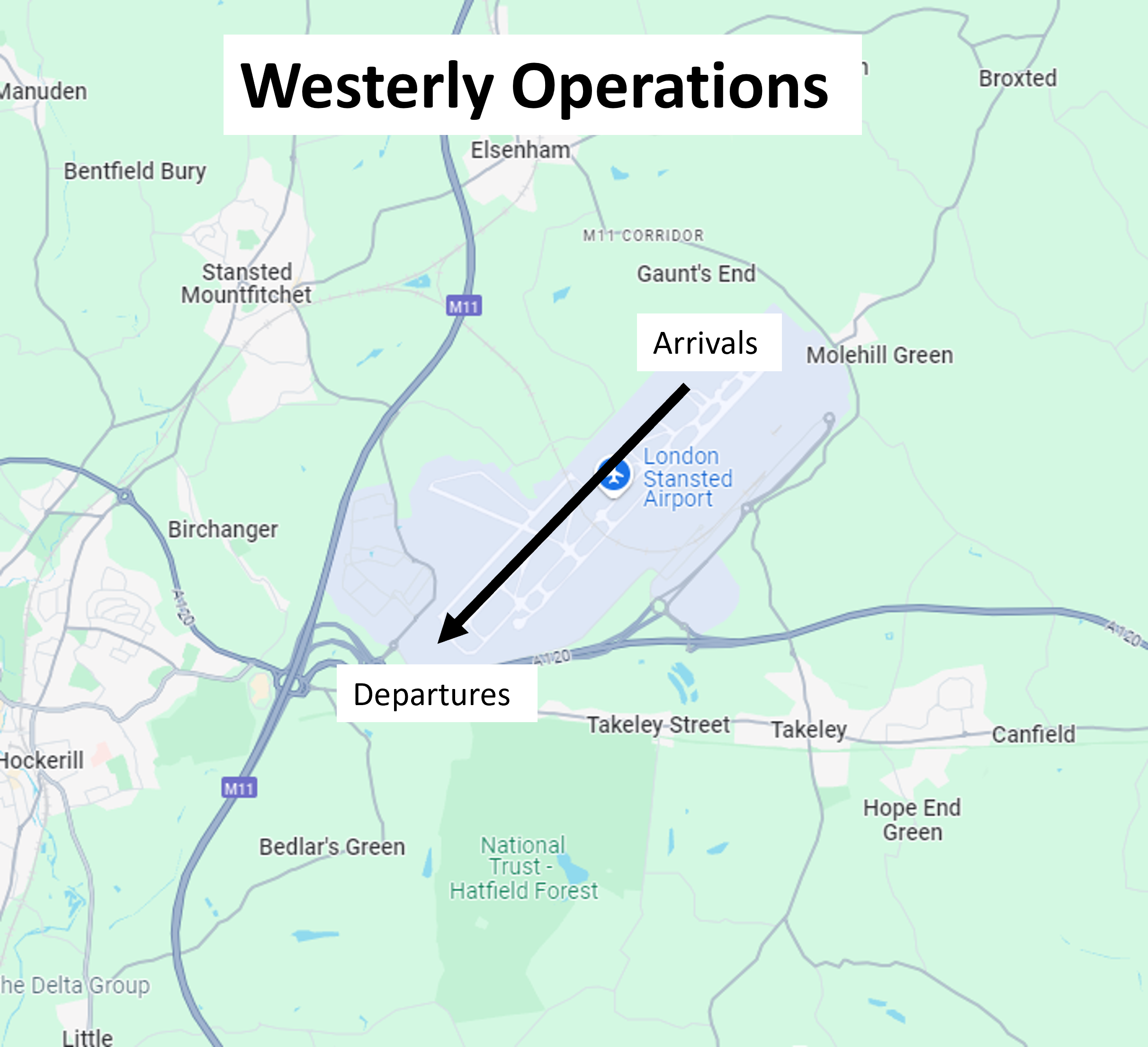
When the wind is blowing from west to east, the airport will operate in a westerly direction, known as “westerly operations” and the reverse during “easterly operations”. Experience of operations at London Stansted Airport shows an average of over 70% of operations, each year, are westerly and the remaining operations in an easterly direction. The 70/30% split is an annual average and there are months with a much higher/lower proportion of westerly/easterly operations. An image demonstrating the direction of operations can be seen below:
Arrivals
Flight paths for arriving aircraft follow broadly similar patterns, unlike departures which are much more defined. The flight paths ensure separation from other air traffic and avoidance of adverse weather when necessary. This means that there may be variation in airport arrivals at different times of the day.
Aircraft arriving into London Stansted Airport are transferred from the NATS area control centre to the Air Traffic Control approach controller, who sequences aircraft into the arrival pattern. They are then instructed where to fly by the Air Traffic Controllers, where they are directed towards their final approach before landing. When established on final approach to London Stansted Airport, aircraft are transferred from the approach controller to the tower controller before landing.
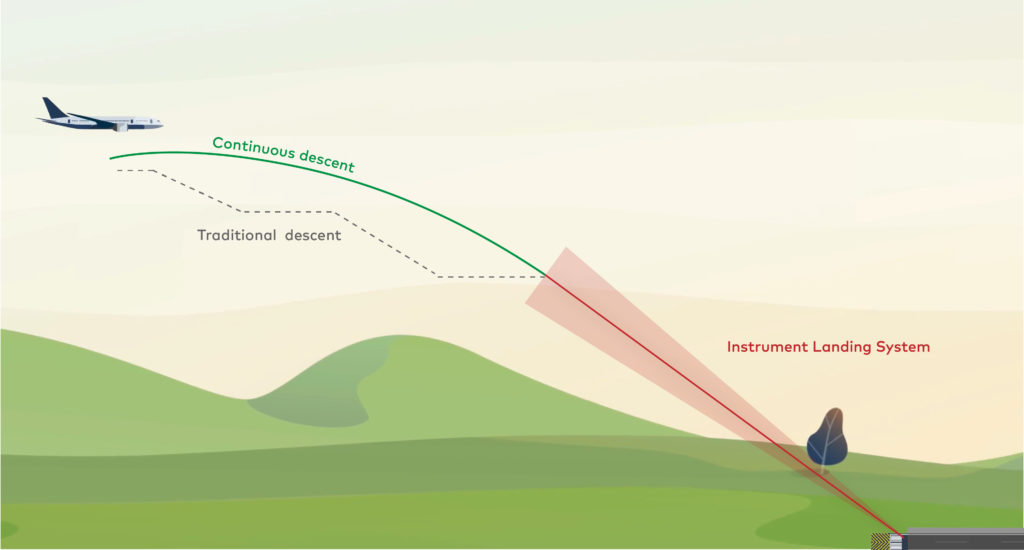
To minimise the noise of approaching aircraft for communities near arrival paths, a ‘Continuous Descent Approach’ (CDA) is used when possible. Instead of a traditional descent whereby the aircraft reduces altitude in a stepped manner (similar to walking downstairs), they glide at a more constant rate (like an escalator). This keeps aircraft at a higher altitude for longer, minimising noise for local residents before an aircraft joins the ILS (the red shaded area in the image below), as well as providing benefits for fuel efficiency and reducing emissions. Operating a CDA is not always possible due to several factors such as congested airspace or adverse weather conditions which need to be avoided. With the London Stansted Future Airspace project, we plan to facilitate changes that will make CDA easier to deliver. Compliance with this procedure is reported on here and you can find out more about arrivals at London Stansted Airport in the following video.
Please note this video is orientated as if you are positioned on the North of the airfield, looking towards the South.
Departures
Departing aircraft move on the ground from their stands to the runway using taxiways. At the runway, they then await clearance from Air Traffic Control (ATC) to take-off. The weight of a departing aircraft can vary due to the amount of fuel, passengers, luggage, or cargo, and there can be a difference in the noise generated as the aircraft accelerates along the runway to become airborne.
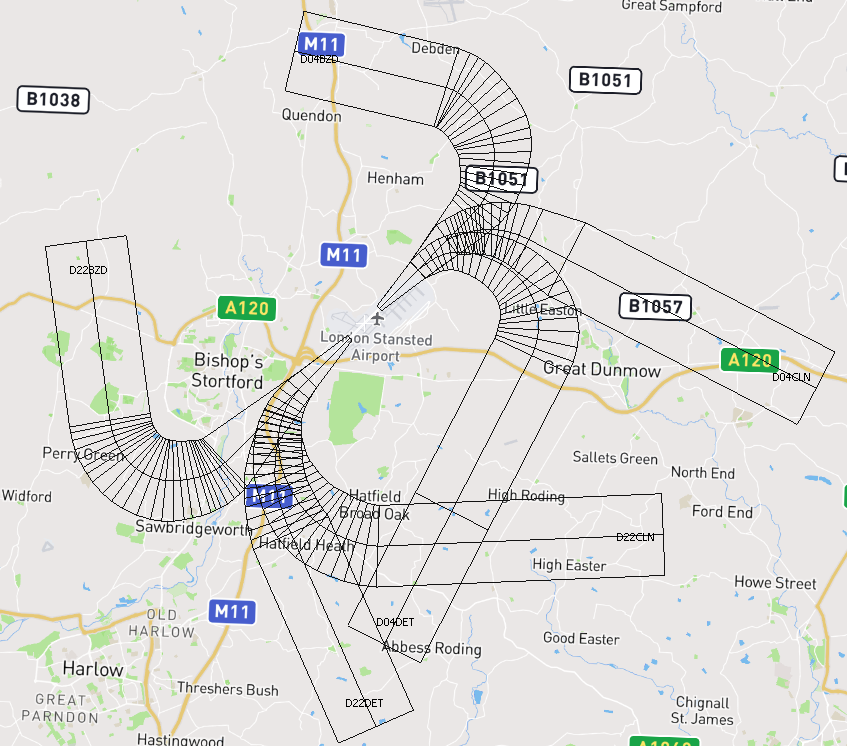
Depending on the aircraft’s destination, the departure will fly one of a number of departure routes (known as Noise Preferential Routes or NPRs). These routes are flown to minimise the overflight of local communities, whilst ensuring separation with other departures and surrounding air traffic, as well as optimising routing to the destination. The NPRs can be seen below. You can find out more about London Stansted Airport departures in the following video.
Please note this video is orientated as if you are positioned on the North of the airfield, looking towards the South.
Aircraft must remain within the NPR until they reach a minimum altitude of either 3,000ft or 4,000ft (depending on the route and time of day or night) after which ATC can provide a more direct routing to the destination. For safety reasons, ATC may sometimes provide instruction to an aircraft to exit the NPR earlier to avoid adverse weather or other air traffic. Compliance with this procedure (known as track keeping) is reported on here.


